Background
Collaborative working is central to what we do at Innoval. The PIVOT project, Performance Integrated Vehicle Optimisation Technology, is a major collaborative R&D programme focused on transforming the way structural aluminium castings are designed, manufactured and assessed for future vehicle applications. The project is led by Sarginsons Industries and supported by the Advanced Propulsion Centre UK and Innovate UK, with a total project value of £5.8 million and £2.9 million of public funding.
PIVOT brings together expertise from across the automotive, aluminium and digital engineering value chains. The consortium includes Sarginsons Industries, Aston Martin, Siemens, Brunel University of London and GESCRAP.
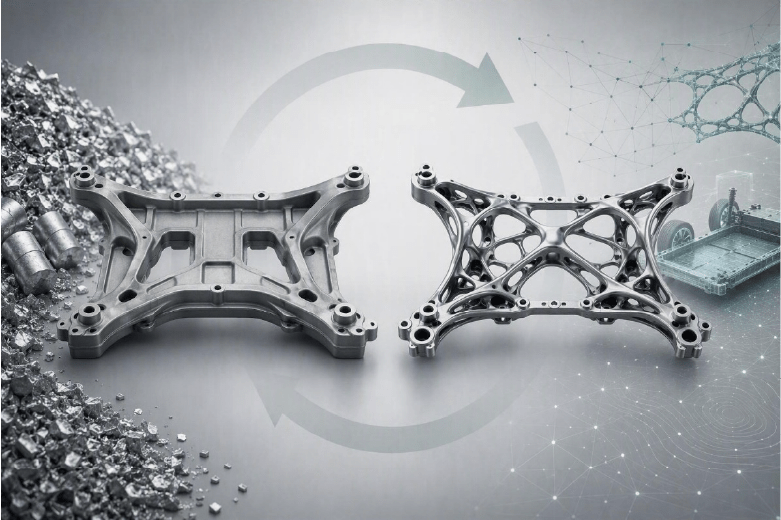
The project aims to develop lighter, stronger and lower-carbon cast aluminium vehicle components by combining casting simulation, topology optimisation, artificial intelligence and advanced alloy development. The ambition is to enable cast aluminium structures that are up to 30% lighter while maintaining required performance levels.
A key part of the project is the use of recycled aluminium. PIVOT is exploring how 100% recycled aluminium can be used in demanding structural vehicle applications, with the potential to reduce embedded carbon emissions in cast components by up to 95%.
Innoval’s involvement
Innoval is responsible for the carbon accounting work within the PIVOT project.
Our role is to help the consortium understand, quantify and communicate the environmental impact of the materials, processes and design choices being developed. This includes building a robust methodology for assessing the carbon footprint of different aluminium casting routes, recycled material pathways and component designs.
This work is about more than calculating a single carbon number. We are helping to create a clear and transparent evidence base so that the project can compare different manufacturing scenarios, understand where emissions arise across the value chain and identify where the greatest reductions can be achieved.
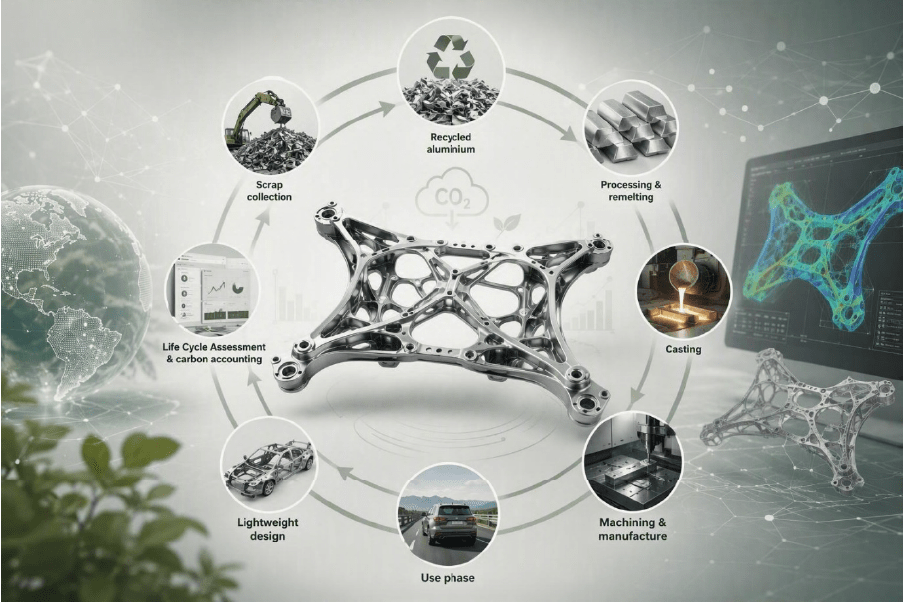
The use of recycled aluminium introduces important carbon accounting questions. These include how scrap is collected, sorted, processed, transported and remelted, and how the benefits of recycling are represented within the overall assessment. GESCRAP has stated that its role in PIVOT includes developing pilot lines for processing new and old aluminium scrap, improving collection and traceability concepts, and helping to make the value chain more sustainable.
By applying our aluminium expertise and sustainability knowledge, Innoval is helping to ensure that the project’s environmental claims are supported by transparent, technically sound analysis. Our work will help the consortium understand the relationship between lightweighting, recycled content, casting process efficiency and carbon reduction.
Why carbon accounting matters
The aluminium industry has an important role to play in the transition to low-carbon manufacturing. Aluminium is lightweight, durable and highly recyclable, but its environmental impact depends strongly on how it is produced, processed and recycled.
Life Cycle Assessment and carbon accounting provide a structured way to compare different material and process choices. These methods are increasingly important for organisations that need to support environmental claims with clear methodology and reliable data. Innoval’s sustainability work includes supporting customers with Life Cycle Assessments and Environmental Product Declarations to provide a transparent view of product life-cycle performance.
For PIVOT, carbon accounting supports both sustainability and engineering decision-making. It can help answer questions such as:
- How much carbon can be saved by using recycled aluminium instead of primary aluminium?
- How do different scrap processing and remelting routes affect the overall footprint?
- What is the carbon impact of alloy additions, heat treatment, casting yield and machining?
- How does lightweighting influence the environmental performance of a component over its life?
- How can recycled content and material traceability be communicated credibly to customers?
This is especially important because PIVOT is not only developing low-carbon materials. It is also developing new ways to design and manufacture castings. The project’s digital approach combines casting simulation, topology optimisation and AI to optimise components for weight, performance and manufacturability.
Outcome
PIVOT is still in progress, but early results show strong potential. In June 2026, Sarginsons Industries reported that aluminium subframes developed through the programme were 17% lighter at the front and 35% lighter at the rear than the components they would replace.
Innoval’s carbon accounting work will help evaluate the environmental benefits of these new designs and manufacturing routes, supporting the project’s aim to demonstrate lighter, structurally capable, circular and lower-carbon aluminium castings.
By linking material provenance, recycling routes, casting processes and component performance, Innoval is helping build the evidence needed for wider adoption across the automotive supply chain.